
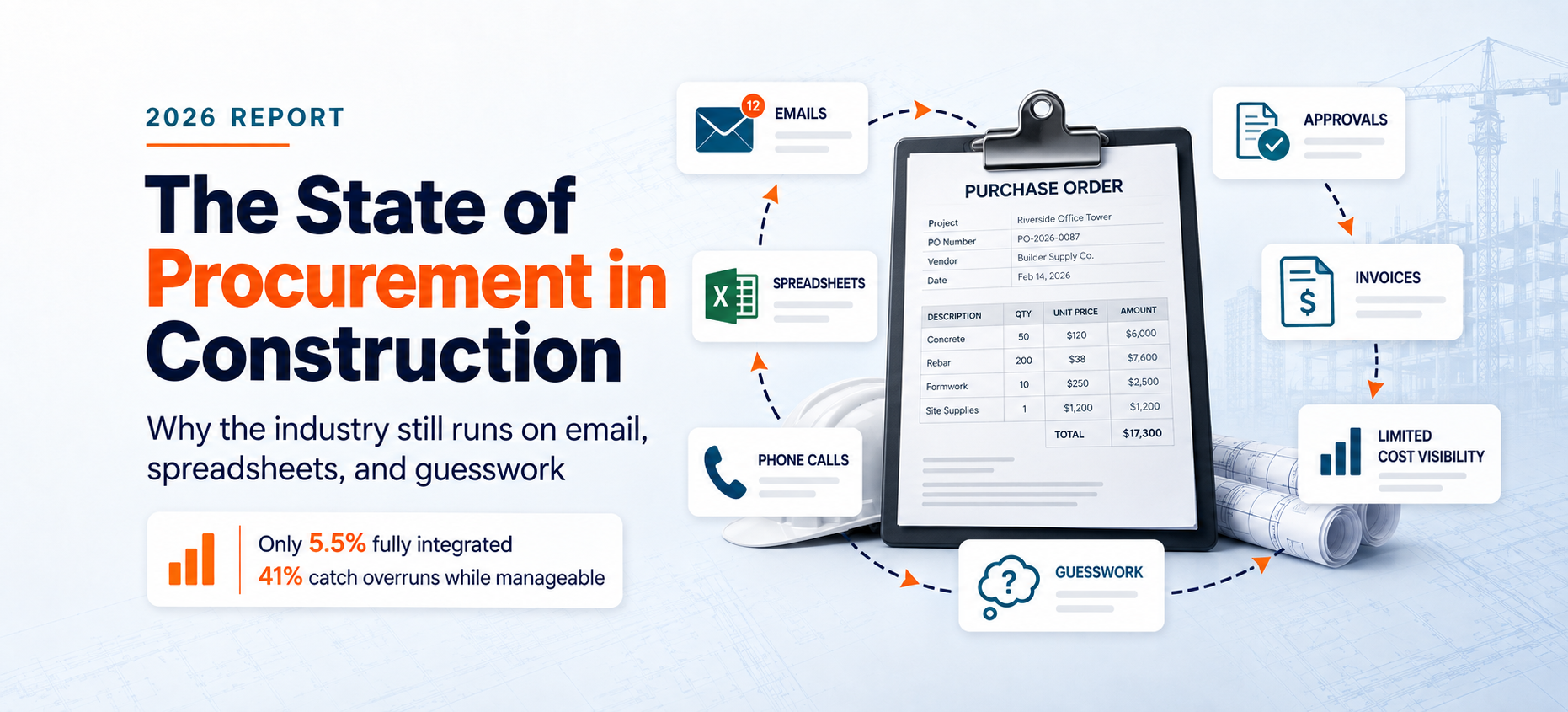
Construction is one of the least digitized industries in North America, and procurement is where it shows most. Most contractors still buy materials by phone, text, and email, with purchase orders living in a spreadsheet or nowhere at all. That means the money a business commits to a job is invisible until the invoice lands, often weeks too late to do anything about it. The good news: real time spend visibility, competitive quoting, and accounting connected purchase orders are finally reaching the growing shop, not just the national GC. And where AI helps most is the quiet stuff, reading a quote or an invoice so a person does not have to retype it.
If you run a construction business, you already know something is off about how the money goes out the door. You just may not have a name for it.
You can tell someone almost to the dollar what your family spent on groceries last month. But if we asked what your team ordered last week, whether anyone got a second price, or whether the order even went to the right vendor, the honest answer for most owners is a shrug. That is not a knock on you. It is the state of the whole industry. And it is worth understanding, because the ground is finally starting to move.
Construction is one of the least digitized industries, full stop
It is not your imagination, and you are not behind your peers. The whole trade is playing catch up.
McKinsey has studied this for years, and construction lands near the very bottom of its industry digitization index, second to last in the United States. High confidence That is not a small gap. It means the tools that other industries take for granted, connected systems, real time numbers, and simple automation, mostly have not arrived on the jobsite yet.
You can see it in the day to day. Surveys of construction technology, notably the annual JBKnowledge Construction Technology Report, have found that core office functions still lean hard on spreadsheets: estimating, accounting, and bid management all show heavy manual dependence. Only about 5.5% of firms have their software fully integrated, and roughly one in three have no integration at all, which means someone is rekeying the same numbers by hand. Medium confidence
~1% a year
Construction's labor productivity growth over two decades, versus 2.8% a year for the total economy. The gap is what happens when an industry does not modernize.
Source: McKinsey Global Institute
Here is the part that matters for your business. Procurement, how you buy materials and equipment, is one of the least digitized corners of an already under digitized industry. It is the last thing to get a real system, even though materials are usually the single biggest cost on the job.
The current state: how contractors actually buy today
Strip away the brochures and this is the real workflow on most jobs.
A PM needs rebar. He texts a supplier he likes. The supplier calls back with a price. He says go ahead and gives them the job name. Somewhere a company card gets used in the field. The materials show up, mostly. An invoice arrives two or three weeks later. Someone in the office tries to match it to a job, a cost code, and a delivery that may or may not have a photo attached. If the price crept up, or the wrong item came, or a cheaper vendor was sitting right there, nobody finds out until it is already spent.
Multiply that by every PM, every super, and every card across five to seventy five active jobs, and you have the current state of construction procurement. It works, right up until it does not.
How buying runs today
- Quotes by phone, text, and email, then lost in an inbox
- POs in a spreadsheet, or no PO at all
- Company cards in the field with no paper trail
- Prices rarely shopped against a second vendor
- Committed cost invisible until the invoice arrives
- Deliveries verified by memory, not proof
Where it is heading
- Quotes requested and compared side by side
- Every purchase captured as a real PO in seconds
- Field buying that still leaves a clean trail
- A quick second price on the spend that matters
- Committed cost visible the moment you order
- Deliveries confirmed with a photo, in real time
None of this is exotic. It is the same discipline a good controller has always wanted. The difference now is that it can happen without slowing the field down, which used to be the dealbreaker.
An owner knows what their family spends on groceries better than what their business spends on materials. They can tell you what is in the fridge. They cannot tell you what their team ordered last week, whether anyone got a second price, or whether it went to the right vendor.
The asymmetry every owner feels, and most tools ignore
Why this is coming to a head now
Three outside pressures are turning a nagging annoyance into a margin problem.
Materials prices are volatile again
After a calmer stretch, input prices have started jumping. The Associated Builders and Contractors reported that construction input prices rose at a roughly 12.6% annualized rate over the first two months of 2026, the fastest pace since the supply chain chaos of early 2022. High confidence When prices move like that, buying the same thing from the same vendor without checking quietly costs you more every month.
Tariffs are stacking onto the biggest cost you have
Deloitte's 2026 industry outlook put the effective tariff rate on construction goods at a 40 year high of roughly 25 to 30%, with steel and aluminum duties reaching as high as 50%. High confidence For Canadian contractors this hits close to home, and it makes shopping a price the difference between winning a bid and eating the overage.
You cannot hire your way out of the admin
The AGC and NCCER 2025 workforce survey found 92% of construction firms are having trouble filling open positions. High confidence When you cannot hire a purchaser or another admin, the only real answer is to take the busywork off the plates of the people you already have. That is the labor story hiding inside the procurement story.
Put those together, thin margins near 5 to 6% for most GCs, materials at roughly 40 to 50% of project cost, prices bouncing, and no one to hire, and the math gets loud. Materials are the biggest lever you have, and most contractors are not pulling it.
The emerging best practices worth knowing
These are the moves the leading builders have already made. Here is how to get there.
Committed cost visibility, in real time
The single biggest shift. Instead of learning your true cost when the invoice arrives, you record the obligation the moment the PO goes out, so the budget reflects reality today. A 2026 study from CMiC and Dodge Construction Network found only 41% of contractors can catch an overrun while it is still manageable, and only 6% have a fully connected view of their projects. Closing that gap is the whole game.
Competitive quoting, made routine
Not a formal bid on everything, just a fast second price on the spend that matters. McKinsey names better procurement and supply chain management as one of the seven changes that could lift construction productivity by 50 to 60%. Digitizing the quote request turns price shopping from a chore nobody has time for into a habit that pays for itself.
Procurement that talks to your accounting
The make or break factor for whether any of this sticks. For a growing shop that means the accounting system the office already runs on. For larger firms it means the ERP. Either way, when a PO flows into your books with the job, the cost code, and the vendor already matched, the office stops rekeying and the numbers stop drifting. It matters because integration is exactly what the industry lacks: the same JBKnowledge data shows only about 5.5% of firms have their software fully connected.
The three way match, automated
Matching the purchase order to the delivery to the invoice is the oldest control in the book, and the most skipped, because doing it by hand is miserable. APQC benchmarking pegs the cost of processing a single purchase order at anywhere from about $14 to more than $54, depending on how manual the process is, so automating the match is one of the clearest returns in the whole procure to pay process. It also kills the classic month end blame game about what was actually delivered.
Field to office, on one system
The reason old procurement tools failed is that they slowed the field down, so the field ignored them. The bar now is simple: a super or PM has to be able to buy from a phone faster than they could text a supplier, while the office still gets a clean record. In fact, 48% of construction pros say they will only adopt software that includes an easy to use mobile app. If it is not fast in the field, it does not exist.
So where does AI actually fit in?
The honest answer, without the sparkle.
You have heard that AI is going to transform construction. Maybe someday. Today, the picture is more grounded. The 2026 RICS report on AI in construction found that about two thirds of construction pros now use AI in some form, which sounds like a lot until you look closer: only about 19% use it regularly, and 39% are still stuck in early pilots. High confidence Adoption is climbing fast, but for most firms AI is still an experiment, not a habit. Anyone selling you a robot foreman is selling you a brochure.
Here is where AI genuinely helps in procurement right now, and it is not glamorous, which is exactly why it works.
What AI is quietly good at today
Reading documents so people do not have to. Point it at a supplier quote or a stack of invoices and it pulls out the line items, prices, and quantities, then turns them into a clean purchase order. The admin that used to eat an afternoon happens in the background.
Matching without the misery. It lines up the PO, the delivery, and the invoice, and flags only the ones that do not agree, so your controller reviews exceptions instead of everything.
Catching the outlier. It can quietly notice when a price is off from what you normally pay, or when the same material is cheaper elsewhere, before you commit.
Notice what all three have in common. AI is not making the decision. You are. It is taking the paperwork off your plate so the decision is faster and better informed. That is the right way to think about it: the benefit comes first, and AI is just the engine under the hood. If a tool leads with the AI and gets quiet about what it actually does for your job, that is your signal to ask harder questions.
What good looks like from here
You do not have to fix everything at once.
The contractors who have gotten ahead of this did not run a two year software project. They picked the one place the bleeding was worst, usually materials spend with no visibility, and put a real process on just that. Every purchase becomes a PO. Every PO shows up against the budget the day it is made. The bigger buys get a quick second price. The invoice matches the delivery automatically. And all of it flows into the books the team already uses.
Do that, and the fridge asymmetry closes. You go from shrugging about last week's orders to knowing, in real time, what your business is committed to spend and whether it was spent well. That is not surveillance on your crew. It is the same control over your business that you already have over your kitchen table, finally applied to the biggest checks you write.
The industry is behind. That is the bad news and the opportunity in the same sentence. The tools that used to belong only to the firms with an ERP team are now built for the growing shop. The contractors who move first get the margin, the calm, and the head start.
Frequently asked questions
Why is construction considered one of the least digitized industries?
Construction sits near the bottom of McKinsey's industry digitization index, second to last in the United States. Core functions like estimating, accounting, and procurement still run heavily on spreadsheets, email, and phone calls, and most firms have little or no integration between the software they do use, so people rekey the same numbers by hand.
What does the current construction procurement process actually look like?
For most contractors, buying runs on phone, text, and email between the field and suppliers, with purchase orders tracked in a spreadsheet or not at all. Company cards get used in the field with no PO trail, so the office does not see committed cost until the invoice arrives, often weeks after the money was effectively spent.
What is committed cost visibility, and why does it matter?
Committed cost is money you have already promised to spend the moment a purchase order goes out, before any invoice arrives. Seeing it in real time lets you catch a budget problem while it is still fixable. Recent research from CMiC and Dodge found fewer than half of contractors can spot overruns while they are still manageable.
Where does AI actually fit in construction procurement today?
The proven use today is document work: reading a supplier quote or an invoice and turning it into a structured purchase order, then matching the PO, the delivery, and the invoice automatically. Most firms are still early with AI, so the honest answer is that it quietly removes admin. It does not run your job for you, and any tool claiming otherwise deserves a hard look.
Do I need to replace my accounting system to modernize procurement?
No. For most contractors, the accounting system is the financial source of truth, and the goal is to feed it better, not replace it. The right procurement layer sends each purchase order into your books with the job, cost code, and vendor already matched, so you get real process without ripping out the accounting your team already knows.
A note on the numbers
We flag every statistic with our confidence in it. High confidence means the figure comes from an authoritative, recent source like McKinsey, the Associated Builders and Contractors, Deloitte, AGC and NCCER, RICS, or a CMiC and Dodge study. Medium confidence means the direction is well established but the exact figure is older or drawn from a broader survey. We would rather show you our work than hand you a number and hope you take it on faith.
Sources
Every stat above, and where to read it for yourself.
- McKinsey Global Institute, Reinventing Construction: A Route to Higher Productivity. Construction ranks second to last on the US digitization index, and construction labor productivity has grown about 1% a year over two decades versus 2.8% for the total economy.
- McKinsey, Decoding Digital Transformation in Construction. Digital transformation can deliver productivity gains of 14 to 15% and cost reductions of 4 to 6%.
- Associated Builders and Contractors, construction input price analysis, reported by Construction Dive (March 2026). Input prices rose at a 12.6% annualized rate over the first two months of 2026.
- Deloitte, 2026 Engineering and Construction Industry Outlook. The effective tariff rate on construction goods hit a 40 year high of 25 to 30%, with steel and aluminum duties reaching as high as 50%.
- Associated General Contractors of America and NCCER, 2025 Workforce Survey (NCCER summary). 92% of firms report difficulty filling open positions.
- CMiC and Dodge Construction Network, 2026 Project Controls Study. Only 41% of contractors can identify overruns while still manageable on at least half their projects, and only 6% report a fully connected project controls environment.
- RICS, Artificial Intelligence in Construction Report 2025 and its 2026 follow up. About two thirds of construction pros now use AI in some form, but only about 19% use it regularly and 39% remain in early pilots.
- JBKnowledge Construction Technology Report, via industry analysis and Sensera Systems. About 5.5% of firms have fully integrated software while roughly 30% have none, and 48% will only adopt software that includes an easy to use mobile app.
- APQC, How Efficient Is Your Procurement Process? (2026). Organizations spend from about $14 to more than $54 to process a single purchase order.