
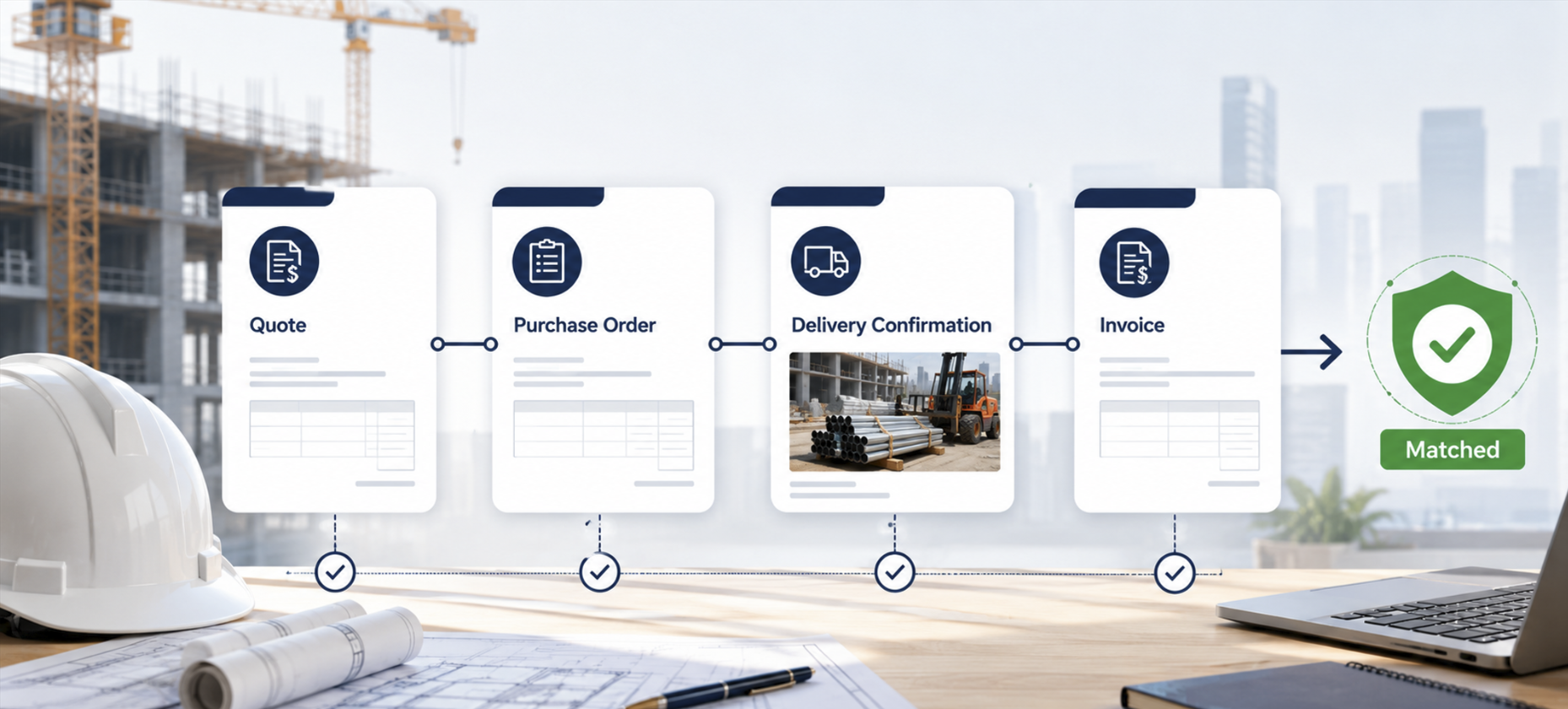
When you approved that invoice this morning, what did you check it against?
If it was the Purchase Order, that is a two-way match. If it was the PO plus proof the material actually showed up, that is a three-way match. If it was the Quote you were given, the PO you issued, a photo of what came off the truck, and the Invoice itself, that is a four-way match, and it is the strongest protocol there is for making sure the money going out matches the work coming in.
And if the honest answer is that you checked it against your memory of what the number was supposed to be, you are not alone. Most contractors are running a one-way match.
Every contractor has done it. An invoice lands. The number is close to what you remember agreeing to, close enough, and the job is moving, so you approve it. You are not certain it is right. You are certain that tracking down the difference would cost more time than the difference is worth. So you pay it and move on.
Do that a few hundred times a month and something quiet happens. The price that crept up between the quote and the bill. The pallet that showed up short. The fixture that arrived cracked and got installed anyway. None of it is worth a fight on its own. Together it is real money leaving the business through a door nobody is watching.
That is not a discipline problem. It is a documents problem, and it has an old, boring, well-tested solution. Once you see how it works, you cannot unsee how much you are leaving on the table.
Matching, in plain terms
Matching is the habit of checking a few documents against each other before you pay a bill. The idea is old and boring and it works: never pay for something until you have confirmed you ordered it, actually got it, and were billed correctly for it.
The most complete version checks four documents. The discipline came out of warehouses and factories, so the classic four are the warehouse’s four. Construction reshapes them, which is where the Quote comes in, and we will get to that. The logic underneath does not change.
The Purchase Order. What you agreed to buy: the items, the quantities, the prices, the terms. It is the promise, and everything else gets measured against it.
The Receiving Report. Proof of what physically showed up. In a warehouse it is a formal document. On a jobsite it is the crew confirming the load. Either way, it answers a question the PO cannot: did the material actually arrive, and did all of it arrive?
The Inspection. Confirmation that what showed up is usable. Not cracked, not defective, not the wrong spec, not water damaged from sitting on a truck. It is the difference between “it is here” and “it is good.”
The Vendor Invoice. The bill. The number the supplier wants you to pay, and the document you are trying to verify before you hand over the money.
Line those four up and the invoice either agrees with reality or it does not. If it does, you pay with confidence. If it does not, you catch it before the money is gone instead of after.
Two-way, three-way, four-way: what each one actually catches
Not every purchase needs all four checks. The right level depends on how much can go wrong between the order and the delivery.
| Two-way match | Three-way match | Four-way match | |
|---|---|---|---|
| Documents compared | PO and Invoice | PO, Receiving Report, and Invoice | PO, Receiving Report, Quality Check, and Invoice |
| Question it answers | Does the bill match what we ordered? | And did the material actually show up? | And was it in good, usable condition? |
| What it catches | Wrong price, wrong quantity billed | Short shipments, paying for material that never arrived | Damaged, defective, or rejected goods you would otherwise pay for |
| What it still misses | Whether anything was delivered at all | Whether what arrived was any good | Very little, which is the point |
| Where it fits | Simple office and service purchases | Most businesses that buy physical goods | Manufacturing, pharmaceuticals, and construction: anywhere condition matters |
Each level adds one more check, and each check closes one more way money leaks out. A two-way match protects you from being billed wrong. A three-way match adds protection from being billed for material you never received. A four-way match adds protection from paying full price for material you cannot actually use.
That is the textbook. Now here is what the same three levels look like in a real week on a real job.
What most contractors are actually doing
Almost nobody is running one clean protocol across the whole company. What is really happening is a different partial match on almost every invoice, depending on who bought the material and how much of a hurry they were in.
Invoice and a delivery slip, no Purchase Order. Someone needed material, called the supplier, and it showed up. There is a slip from the truck and a bill in the inbox, and they agree with each other, so it gets approved. What is missing is any record of a price you agreed to. You have confirmed that the material arrived. You have confirmed nothing about what it was supposed to cost. Whatever the supplier decided to bill becomes the price, by default, because there is no other number to compare it to.
Purchase Order and Invoice, no Delivery Confirmation. This is the office version, and it feels rigorous, because two documents are being compared and they line up. But both of them were written before the truck ever left the yard. The PO says what you ordered. The Invoice says what was billed. Neither one is evidence that anything arrived. Order forty, get thirty-four because six were on back order, get billed for forty. The match passes. You have just paid for six of something sitting in a warehouse across town, and the only person who knows is the guy who signed for the load and never mentioned it because he assumed the office had it handled.
Invoice alone. The vendor is familiar, the amount is in the usual range, the job is real, so it gets coded and paid. This is where duplicates live. The resent invoice that gets paid twice. The statement paid alongside the invoices it summarizes. The small monthly rental charge for a piece of equipment that came off the site in March.
Purchase Order, delivery confirmation, and Invoice. Now you are running a genuine three-way match, and you are ahead of most of the industry. Everything you ordered arrived, and the bill matches the order. And you can still be overpaying on every single line.
The pattern underneath all four is the same. Every one of these feels like a control, because a document is involved and the documents agree. What is actually happening is that one leg of a four-legged claim is getting verified and the other three are being taken on faith. The invoice is not wrong very often. It just is not proven right, and over a few hundred invoices a month, “not proven right” is where the money goes.
The document nobody checks
That last one is worth sitting with, because it is the version most contractors are working toward, and it still has a hole in it.
A three-way match never asks where the number on the PO came from.
Somebody shopped that material. They got prices, they picked one, they awarded it. Then the PO got written, sometimes off that quote, sometimes off a phone call, sometimes off what the last job cost. Then weeks pass. Material prices move. The quote quietly expires. The supplier substitutes a similar item at a higher price. A freight charge appears that nobody discussed. The rep who gave you the number is not the person who entered the order.
And it clears every check you have. It matches the PO, because the PO was already carrying the wrong number. It matches the delivery, because the material genuinely did show up. The only document that would have caught it is the Quote, and the Quote is not in your system. It is in an inbox, or a text thread, or a folder on somebody’s laptop, if it still exists at all.
So this is the real story, and it is a quieter one than short shipments and damaged goods. You are not usually paying for material you never got. You are paying, over and over, against pricing that was never on the original quote. Nobody stole anything. The price you agreed to and the price you were billed simply live in two different worlds, and no one has ever put them side by side.
Why condition matters more in construction than most people think
The physical side still bites, and it bites harder here than almost anywhere.
In an office, the worst case on a bad order is a keyboard that does not work and gets sent back. In construction, the worst case is that the defective material does not get sent back. It gets installed.
The bundle of trim that was warped but went up anyway. The fixture that was the wrong finish but was close enough under a deadline. The short pour that nobody logged. Every one of those is money paid for something that either failed a quality bar or was never fully delivered, and the bill does not stop at the material. It carries into the cost of tearing the work out and doing it again.
That is not a small line item. The Construction Industry Institute has measured rework at roughly 5 percent of total project cost on the average project, and a meaningful share of that traces back to material that was wrong, damaged, or short and got caught too late, or never caught at all. The condition check is the cheapest place in the whole chain to catch it, because it happens before you have paid and before the material is buried in a wall.
Where your accounting system runs out of road
The obvious question is why the software you already pay for does not just do this.
Most accounting platforms can handle a rough two-way match. You create a purchase order, and when the bill comes in you link it back to that PO. That is genuinely useful, and it catches a wrong price or a wrong quantity on the invoice.
The limit is not a knock on the software. It is a question of what the software can see. Your accounting system lives in the office. It has no line of sight to the back of a truck at seven in the morning, so it holds no record of what actually came off that truck, how much of it came off, or what condition it was in. It has never seen the quote either, because the quote arrived as an email attachment weeks before anyone opened the accounting system. Without those records there is nothing to run a three-way match against, and a four-way match is not on the menu at all. It was built to be your system of record, not to stand on the jobsite and confirm what arrived.
So the verification does not disappear. It just falls on a person, usually the controller, usually at month end, working backward from a stack of invoices and a credit card statement, trying to reconstruct what was ordered and whether it all showed up. That reconstruction is slow, it is easy to get wrong, and it is exactly how duplicate and erroneous payments slip through. Accounts payable benchmarks commonly put those errors at 1 to 2 percent of everything a company pays out. On a few million dollars of annual spend, 1 to 2 percent is not a rounding error. It is a truck.
What a four-way match looks like on a jobsite
If you have ever taken a delivery on an active site, you already know the textbook version does not quite fit. You do not have a receiving dock and a quality inspector in a lab coat. You have a supervisor or a project manager checking a load in the rain while three other things are on fire.
So the four checks take a different shape in construction.
The Receiving Report and the Quality Check collapse into a single moment: a Delivery Confirmation with a photo. When the material lands, someone on site confirms it and photographs it. That one step proves what arrived, how much arrived, and what condition it arrived in. The warehouse needs two documents to do that. The jobsite needs one honest photo, logged against the order the moment it happens instead of reconstructed at month end.
That frees the fourth slot for the document construction actually needs in it: the Quote. Not a price someone remembers agreeing to, but the competitively shopped price you were given, captured when it was given and held against the final bill.
That is how QuoteToMe runs a four-way match for contractors. The four documents are the awarded Quote, the Purchase Order, the photo-confirmed Delivery Confirmation, and the Invoice. Each one catches a specific leak. The Quote catches price creep. The Purchase Order catches wrong quantities and terms. The Delivery Confirmation catches short and damaged loads. The Invoice is the bill all three are measured against.
When all four agree, the Invoice clears on its own. When one of them does not, the Invoice is held and flagged for a human to look at, instead of sailing through because everyone was busy. Only the clean, matched result posts to your accounting system, already coded to the right job and account. The controller stops playing detective, because the detective work already happened, automatically, the moment each thing occurred. Contractors running this way report invoice approvals 50 to 80 percent faster, because the checking is no longer a month end project.
Josh Paul, who runs operations at Complete Power Solutions in Edmonton, put the result plainly. QuoteToMe, he said, “saved us the cost of a full-time purchaser, reduced admin time on invoice entry, and ensured nothing slips through the cracks.”
Back to that invoice
Remember the invoice from the top. The one you approved because it was close enough and chasing it down was not worth your afternoon.
A four-way match is what turns “close enough” into “correct.” It does not ask you to work harder or trust your people less. It just puts the four documents that matter in front of each other so the math is done before you sign, not argued about after. You approve the ones that add up, and you spend your time only on the handful that do not.
That is the whole game. Not watching your team harder, but finally knowing that the money going out the door matches the work that came in, at the price you were actually quoted. QuickBooks will keep the books beautifully once that is true. It just needs something standing at the back of the truck first.
From one builder to another, that is a door worth closing.
Want to see what a four-way match does to your invoice pile?
Connect your accounting system to QuoteToMe and start matching Quotes, Purchase Orders, Delivery Confirmations, and Invoices for free.
Get Started for FreeSources
- Rework at roughly 5 percent of total project cost on the average project: Construction Industry Institute.
- Duplicate or erroneous payments at roughly 1 to 2 percent of accounts-payable spend: Association for Financial Professionals and industry accounts-payable benchmarks.
- Invoice approvals running 50 to 80 percent faster once every charge arrives already matched and coded: QuoteToMe, quotetome.com.
- Customer results, including saving the cost of a full-time purchaser and reducing invoice-entry admin time: QuoteToMe customer account from Complete Power Solutions, Edmonton, quotetome.com.